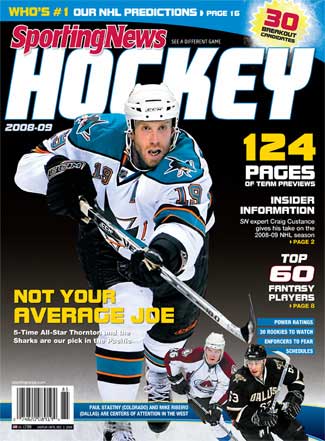
SPORTING NEWS/STREETANDSMITH'S 2008-09 NHL PREVIEW
It is that time of year to review the 2008-09 NHL season preview publications. All of the annuals are very solid this year, but the Sporting News/Street and Smith's
2008-09 NHL Preview stands out with a focus on statistical analysis and feature length articles previewing the season.
Sporting News plays it very conservative with NHL predictions, calling for a Detroit Red Wings Stanley Cup win over the Montreal Canadiens in their 100th anniversary season. The Pacific Division, labeled last season's toughest, will improve even more. The Sporting News notes that a team from the Pacific has reached the Conference Finals in each of the last 5 seasons. The Ducks will benefit from having a non-retired Scott Niedermayer from the start of the season, and the new media darling Dallas Stars will continue to improve with Sean Avery running interference.
Regarding the Sharks, the Sporting News notes that 4 new additions all having something in common. New head coach Todd McLellan, and defenseman Dan Boyle, Brad Lukowich, and Rob Blake all have won Stanley Cups. A quote by Doug Wilson notes that the Sharks have averaged 104 points over the last 5 years, but that the Sharks are looking to make a push deeper in the playoffs. Todd McLellan was quoted saying that there are "real parallels" between the Sharks and Wings, and the Sporting News believes McLellan may try to replicate the Wings puck possession style with Dan Boyle at the helm.
The breakout candidate for 2008-09, there was one selected for each team, was
Joe Pavelski based on his career high 19 goals in 2008-09 and 9 points in 13 playoff games (3 game winning goals). Out of the all of the San Jose Sharks
franchise leaders, the Sporting News cunningly notes the Sharks top 3 alltime scoring leaders: Patrick Marleau - 539, Owen Nolan - 451, and Jeff Friesen - 350. Marleau is coming off a playoff performance against Calgary which may define his career, Owen Nolan is looking to break the 20-goal plateu after signing a 2-year $5.5 million contract with the Minnesota Wild, and Jeff Friesen is on the bubble looking to make a comeback with the San Jose Sharks in a depth role.
Ranking the Sharks, Sporting News gives the offense a 4, the defense 5, goaltending 5, special teams 5, coaching/management a 3, with a final ranking 92/100 (trending steady). Sporting News calls the Pacific: San Jose, Anaheim, Dallas, Phoenix, Los Angeles.
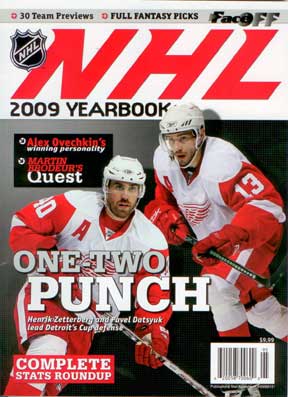
NHL PUBLICATIONS 2009 YEARBOOK
The official
NHL 2009 Yearbook remains above the fold on season predictions and numerical grading, but focuses on in-depth features and an exhaustive look at each individual team.
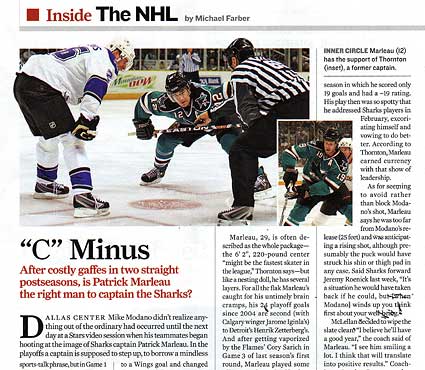
Two things that stand out from the NHL Yearbook, a quote by San Jose Sharks goaltender Evgeni Nabokov mentioned that Ilya Kovalchuk, Evgeni Malkin, and Alexander Ovechkin were able to excel and thrive because they are a product of a modern Russian society that is more open to outside influences. Another offseason quote by rookie San Jose head coach Todd McLellan called the Sharks Patrick Marleau's team. McLellan did not question Marleau's captainship, but he did want to sit down this offseason and talk about leadership and the responsibilities that go with it.

THE HOCKEY NEWS 2008-09 NHL YEARBOOK
The Hockey News
2008-08 NHL yearbook also plays it conservative with its NHL predictions, calling for a familiar Detroit Red Wings Stanley Cup win over the Montreal Canadiens. A look a little furthur down in their Western Conference playoff bracked is a little more surprising. After Detroit and San Jose finish 1-2 in the Conference, the unheralded Minnesota Wild are predicted to take home third place. Dallas, Anaheim, Edmonton, Chicago and Calgary are the remaining playoff teams. That leaves Nashville (9th) and Phoenix (10th) on the outside looking in. Phoenix is thin on defense, and Bryzgalov can have bouts of inconsistent play, but the high-end talent that the Coyotes have developed can have an immediate impact. Chicago will get all the media attention, Los Angeles and Dean Lombardi may be the team of the future, but the Phoenix Coyotes have a real chance to shock people this season. Much more on this team in a future post.
The Hockey News notes that playoff failures precipitated a chance from general manager Dean Lombardi, one to bring in new head coach Todd McLellan and 3 new defenseman. Doug Wilson told The Hockey News that the Sharks were bogged down last season, and that you can not hope for a change you have to make it happen. The Sharks strengths were listed as goaltender (Nabokov) and a strong top 6 forward core. Weaknesses were listed as balanced scoring from the entire lineup, and consistent special teams.
THN notes that the Sharks had the NHL's top penalty kill
85.8% in the regular season, but dropped to
75.0% in the playoffs. 1 goal games the Sharks were 26-7-10, 2 goal games 11-10, 3 goal games 12-6. Offense 2.63 GPG (19th), defense 2.28 GAA (3rd).
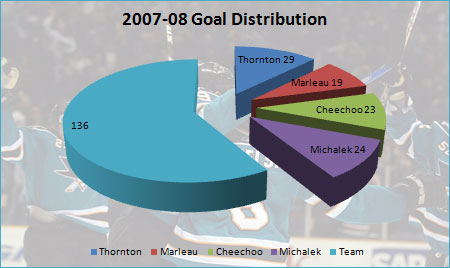
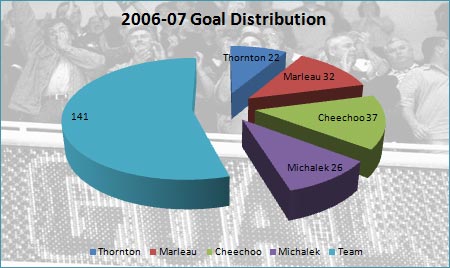
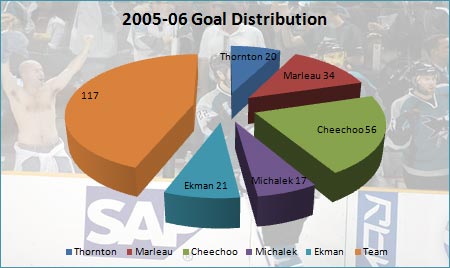
The numbers referenced by THN point to accurate trends with regard to the Sharks season in 2007-08, a strong defensive team with a solid record in close games, spectacular goaltending, top heavy scoring. THN predicts the Sharks will finish 2nd in the Western Conference. THN predicts the Sharks need more balanced scoring up front, and they need Marleau, Cheechoo and Michalek to show that last year's scoring drop-off was a fluke.
THN's Future Watch lists Couture, McGinn, Kaspar, Greiss and Petrecki in order as players to watch for the San Jose Sharks future. You can reverse that ranking and have more accurate look. Petrecki is the Sharks premiere blue chip defensive prospect along with former Princeton defenseman Mike Moore. Thomas Greiss has shown tremendous athletic skill on the ice, but he will benefit with another year or two locking down the mental game with the AHL Worcester Sharks. Many publications have him pegged as a future backup to Evgeni Nabokov but Greiss has #1 goaltender potential down the line. Kaspar and Couture have high end offensive instincts and skill, but Jamie McGinn was the name many hockey people in San Jose were talking about during training camp.
Last year's preseason NHL annual review is available
here.

ESPN MAGAZINE CAMPAIGN 2009, OVECHKIN FOR PRESIDENT
[Update] Upstart
ESPN Magazine was the most entertaining read of the season preview annuals. Fully on the Ovechkin/Capitals bandwagon, ESPNmag offers an election campaign theme for
Ovechkin 09. Throw in any pun you can imagine and it is there, head of state, secretary of defense, grande old party, commander in chief, mutually assured destruction... wait. You might cringe a little bit with the reference to McCain and his 5-year experience in a POW camp, Obama and his 2004 convention speech, and Ovechkin's game against Pittsburgh where he took a skate to the leg causing a 6 inch gash, only to play 2 games later. The photography itself is priceless.
"Today I am president, so there is no speed limit!" - Alexander Ovechkin
Regarding the predictions, ESPN drinks the Dallas Stars cool aid ranking the Pacific Dallas (A+), San Jose (A), Anaheim (A-). ESPN ranks the Sharks offense 4 out of 5, defense 4, special teams 4, goaltending 4, coaching 3, and punctuates the rankings with an ominous stat "No Sharks defenseman scored more than 5 goals last year". Nick Petrecki is noted as the key prospect in the organization to look out for, no argument here. The question is will he come out this season after his second year (won a NCAA Championship last season), after his third season like former Sharks defenseman and Hobey Baker winner Matt Carle (who won 2 championships), or after a full 4 years. With Boyle, Vlasic, Ehrhoff and Murray locked up long term, the Sharks have plenty of time to let him develop into what one NCAA forward called "the most difficult defenseman to play against" in college.
E.J. Hradek and ESPN Magazine Staff's season predictions and full season preview is available
here. ESPN goes off the board selecting Detroit over Pittsburgh, with Capitals over the Stars as their alternate universe choice.
I would vote for Ovechkin, but only with Olaf Kolzig as VP. Sorry
Ted Leonsis. A video from ESPN of Ovechkin's cover shoot is available
here. An article on the photo shoot is available from ESPN's Eric Adelson
here.
[Update2] James Mirtle sent a link to the McKeens Hockey 2008-09 NHL preview issue, which can be purchased
here. Max Giese notes that the McKeens preview "is for the hard-core fan and fantasy hockey enthusiast. We have scouting profiles on a dozen players per team. There is a prospects ranking of the top 130 prospects and top 30 goalies. Many prospect profiles are available too." Both Mirtle and Giese contributed to the issue.
Max also notes that McKeen's predicts the Stars will win the Pacific Division, and that San Jose will finish second with 101 points: Dallas, San Jose, Anaheim, Phoenix, Los Angeles. Joe Thornton will lead the team with 90 points, Marleau and Michalek tied for second with 61 each. Clowe was selected as the breakout player on the Sharks roster for 2008-09. Logan Couture (71), Nick Petrecki (93), and Steven Zalewski (117) crack the top 130 in McKeen's 2008-09 prospect rankings (former Shark Ty Wishart, now with Tampa Bay is 94th). Thomas Greiss (14) and Timo Pielmeier (29) crack the top 30 in goaltending prospect rankings. McKeen's also predict Steven Stamkos will win the Calder trophy as the top rookie, with Danish Phoenix Coyotes prospect Mikkel Boedker finishing third.

THE WAVE MAGAZINE'S 2008-09 SAN JOSE SHARKS PREVIEW
[Update3] The only NHL season preview magazine you need this season, and it is free, is The Wave Magazine's
2008-09 San Jose Sharks preview. The veteran reporters from the Wave Mag previously covered how La Villa's Chris Combo Sandwich directly resulted in Joe Thornton's
MVP season. San Jose center Joe Pavelski is the cover player for the 2008-09 issue.
This year Anne Ward Ernst
interviews three new Sharks, head coach Todd McLellan, and defenseman Dan Boyle and Rob Blake. The WaveMag also previews players to watch, interviews SJ Sharkie, posts a family pack game schedule, and previews merchandise and restaurant options for the upcoming season.
The Wave: The power play in Detroit had a different look than the Sharks' power play. Detroit was known for sharp, quick passing. Will we see some of that here?
Todd McLellan: We hope to see it here; that's what the plan is. It's about the players understanding what we want to accomplish and then feeling comfortable enough to do it. That's going to take some time. I'm not naïve enough to think that the power play was a disaster here there were some good things that happened on the Sharks' power play. There are just some changes we want to make in how we execute.
The Wave: What will you do differently to get the team past the second round in the playoffs?
Todd McLellan: I've been asked that question so many times, and the answer that I'm now giving is [that] the will has to go up because the skill is there. But we're talking about something that's so far away. I'm more concerned about what's going to happen in the next hour, and what's going to happen tomorrow. It's a long process, and if we take care of that as the year goes on, we'll have a better idea of where we're going when [the time comes for] the playoffs. I'm more about living in the present than thinking about the future.